Uncategorized

Missions to an unreached people group

Two Idaho Falls churches are currently involved in efforts to bring the gospel and plant reproducing churches to unreached people groups in an Asian country.  The following is a brief account of one of them. Because of sensitivity of this work, names have been omitted.

(the following was taken from a letter written in 2013, and will later be updated and expanded)

In 1998, one of the larger churches in Idaho Falls felt burdened to adopt an unreached people group somewhere in the world, with the goal of working for them and with them until, by God’s blessing, a healthy, functioning group of believers was established.  In 2000 the congregation selected a particular indigenous minority group in an Asian country.

This project has been ongoing since that time.  As of 2013, there was not a full Bible in the language of this people nor a self-sustaining group of believers, but there has been progress.  When the church decided to adopt this people, there were few known believers, save for a tiny remnant from missions activity 50-some years earlier.  Now there is at least one functional church in one of the two province where this people group reside, and perhaps as many as several thousand believers scattered around a 200,000 square mile area.  A translation of the New Testament in the native language was published in 2008 and translation of the Old Testament is underway.

The initial primary connection of the Idaho Falls church to this unreached people group was a family from the church who lived among the people in Asia for six years, getting a feel for the challenges to reach them, making friends among the people, studying languages, and assessing what resources were already in the area for spreading the gospel.  During that period, the church also formed and sent also sent five groups of short-term missionaries who taught English camps during the day and built relationships as best they could.  As of early 2013, 30 different people from the church have gone to Asia as part of these mission efforts.  During the 2011 trip, the team was able to attend a festival that culminates with sacrificing a lamb.  This set up the opportunity for one of the team members to present to a small group the redemptive analogy of the Lamb of God. Additional trips were made most later years.

The church is committed to reaching this people group.  The majority of the people in this group are animists and do not know the God of grace.  When the church took on the challenge, no one knew how long it would take to see God establish a reproducing native church, which is their ultimate goal.

Glimpses from My Life – Rebecca Mitchell

The pictures of ideal characters in fiction even under the most artistic hand, or the power of the greatest imagination, can never surpass in portraiture or characteristics the reality of individual experience.  Thinking people are loath to give out to the world their sacred experiences, hidden away within the Holy of Holies of their lives, where none dare intrude.
Rebecca Brown Mitchell

What busy days they were, spinning the wool to be woven into cloth for the winter’s clothing, caring for the lambs of the flock, driving in the sheep and cows at night, no idlers, nor drones, but each did his or her share of the daily work. Behind the farm house was the blooming orchard, laden with its perfume, or rosy with fruit, which was a never ending source of delight.

The country was new and school privileges scarce, while but few books were available, but Scotch-Irish blood and convictions in a deacon’s household made all the family Bible students.  From this Christian home I went in my nineteenth year to be a farmer’s wife, but only a few years passed when death entered the home and took the husband and father from my side.  Though I was but a child in experience, yet now I must take a woman’s responsibility with a world to face alone.  It was at that time when coming in personal contact with existing conditions, that I was awakened and took in the legal restrictions of my sex, which has been as a fire shut up in my bones, permeating my whole being and making me what I am along the lines of independent thought, and willingness to endure hardness, that citizenship for women might be won.

According to the law of the State, the Court appointed appraisers, who came into my house, overhauled trunks, drawers and closets, putting a price on my own goods which I had brought from my father’s house, with one exception, my Bible and hymn book, which they handed me, saying, “These are exempted by law.”  Thus I had to buy back that which was my own by personal right.  But if I had died, my husband would have gone on in full possession of all the property, to use or to keep as he liked regardless of the rights of the children.  This unjust discrimination of the law against women, seeing that they were not consulted as to birth, having no choice as to sex, color or country, was to me in the light of my new experience, heathen and not Christian in any sense of the word.  This was to me a violation of the sacred rights of self-government and of the oneness of the marriage relation as taught in the Bible.  I was like a prisoner in the iron cage of the law, while I studied and tolled, ever lifting my face upward to a Father which I could never believe cared less for His daughter than His son.  The voice of God and of humanity was in my soul, but I chafed in silence, for at that time women were to be seen and not heard, but still the cry from the great mission fields was ever sounding in my ears.  I sought the path of duty and opportunity along the lines of the church, but was hedged out by public opinion and sex prejudice from active service into which the Lord called me. When my two boys were grown and married, I went to a missionary training school in Chicago for a few months, in preparation for work, and in June, 1882, turned my face toward the Great Unknown West, not knowing the whereabouts of my final destination, but was led by God, and so I found myself in Idaho, in the town of Eagle Rock, now Idaho Falls, coming as a self-supporting missionary of the Baptist Church.

What this new territory was at that time can hardly be understood by people in the Old World, a part of the Great American Desert as given in our geographies of forty years ago, but the kiss of nature has transformed the desert into fruitful fields, dotted with thousands of homes, and many schools of high grade as well as primary.  Through this wild country, the home of the Redman, came a few trappers and hunters, who were largely squaw men, and miners heading to the great mining country to the North.  This road crosses the Snake River at this point.  The banks of the river are solid walls of lava rock, and the river looks like a great crack in the earth made by and earthquake while in some places it is claimed that the bottom cannot be found, the current is very swift, dashing the water upon the rocks with such force that it lashes into foam and roars like the sea.  The town was then a row of company houses, built by railroad employees, with shanties here and there, besides a few business houses and the ever-present saloon plying its trade.

It was the morning of June 5th, 1882, when I stepped from the train and into the new world.  No hotel or furnished room could be found where I could find shelter and rest.  All day long I waded the sand shoe top deep in some places, going from house to house, where I found a welcome, but no room.  Late in the afternoon I found a shanty that I could rent, which had been used for a saloon, into which my daughter and I gladly moved our trunks and were at home, amid such surroundings that a change of world could hardly be greater.  I bought a candle, and for a candlestick used an empty beer bottle.  After sweeping out the room, I spread a comfort on the bare floor for a bed, and committing our souls and bodied to the care of the ever-present Father, we slept the sleep that faith alone can give.

I found no church or church organization on this line of road from Ogden, Utah to Butte, Montana, a distance of four hundred miles.  Neither tree, nor grass, nor bird was to be seen on the streets, but sand, sand everywhere.  But when the sandstorms came, it was beyond description.  My first work was a day and Sunday school, which I named Providence Mission, because by unexpected and unplanned journeys the Lord had transplanted me into this needy field.  As nothing better could be found, I transformed my shanty into a chapel and schoolroom of the most primitive kind imaginable, having no furniture same two benches, which served at night for a bedstead and by day for seats for the larger pupils, each having a box in front for a desk.  The smaller children had two boxes, one for a seat and one for a desk.  But how those children did study, making progress not without standing for want of everything needful in the way of equipment.  I never halted, doubted or hesitated, accepting every privation without murmuring or looking back to the world left behind with regret.  My motto was “all things are possible to him that believeth” (Mark 8:23).

Before the end of the first month my purse was empty, the cost of living was much more than expected.  I had sent home for funds, but the expected remittance had not arrived.  My daughter had been sick and craved some pickles.  I had given her the last nickel with the assuring promise on my lips, “The Lord will provide.”  That very day at noon, a prominent railroad man and a patron of my school, (Frank Reardon) who had laughed at me for saying “Providence Mission” came and handed me the tuition for his boy.  I said with choked emotion, Mr. Reardon, why did you do this?  Did you know that I had spent the last cent, and now you come and pay your tuition before it is due?  What do you call this but the Lord’s direct provision for our need?”  He said, “It does look like it,” and ever after while he remained in this country, he and his family gave me many a comforting word, and more substantial help.

Early in November winter set in, with deep snow and severe cold, which made it impossible to live longer in the shanty.  But by this time, a better place, though very small, was secured, which served me to the end of the first year’s work, after which reasonably good accommodations were opened for my school and home.  I began at once to raise money by writing letters to people in the East who were interested in Home Missions, to build a church.  I was greatly aided by Rev. Dwight Spencer of New York, Superintendent of Baptist Missions in the West.  In this work I happily succeeded during the third year, and in November, 1884, the little chapel was dedicated.  It was the beginning of a new era in Snake River Valley when the bell rang out the hour of prayer.  The Sunday school had prospered; good attendance and faithful co-workers had made the school a landmark to be seen afar.  By this time people were coming into this new country to take land and make homes.  It was slow work, but year by year the population increased as emigrants realized the fertility of the soil and the healthfulness of the climate.  In 1886, a national organizer of the W.C.T.U. came to Eagle Rock and organized a local union of which I was president. Some months later a convention was called at Boise City, when the unions were organized into a territorial union.  I was a delegate to that convention, and took my first lesson in convention work.  I still followed my school work, but in 1891 I was elected State organize and Superintendent of the Franchise, which put the legislative work in my hands.  My daughter being now married, a pastor of the church located, and a public school running, I was free to drop the school work and enter this open door, which gave such opportunities not only to come in contact with people, but to learn much of the social, political and religious condition of the State.

My first legislative work was securing the passage of a Bill raising the age of consent for girls, from ten to eighteen years, at the same time working for an amendment to the constitution granting the right of suffrage to women.  In this I failed at first, but kept on knocking until the Bill passed the next session of the legislature.  The amendment aroused many women outside the ranks of the W.T.C.U., and much help was given by them, writing letters and personal interviews with the members.  But the great battle was to be fought at the Polls at the next general election.  In the meantime, earnest prayerful work was to be done.


Justice and truth are fixed eternal principles.  But the world of mankind has leaned away from this tower, until the standard of right in heathen lands lies prone upon the earth at right angles with justice.  The will or the passions of men being the recognized law.  Thus the man holds the life of his wife in his hands as absolutely as the life of his beast, or as any tyrant the life of his meanest subject.  Women are bought and sold and driven like cattle or even worse.  Then this Heathen Standard moves up a little place, where a man may not kill his wife, though he can sell her.  She may eat in his presence and speak to him.  It moves again, the woman is consulted as to her husband, though a slave in every way afterward.  Thus step by step a whole humanity is now being lifted by the Law of Righteousness and truth out of the deepest degradation and moved upward toward the perpendicular.  But as yet there is not a nation in all the world, Christian or non-Christian, that gives to the daughter the same moral, legal, educational and parental rights that the son claims for himself and keeps.  But Election Day dawned upon us, with all its momentous possibilities, cold and stormy, but the club women and W.T.C.U. were abroad at work.  Coffee rooms were opened, and by every means courteous, we urged upon the voters the justice of our cause.  In one place the women hired two boys to go out with placards on their breasts, with this petition “Vote for your Mothers.”  A day of deep anxiety and trial to many of us.  As I stood as near the polls as possible, speaking to the voters as they went into vote, I said to one of the old pioneer citizens of our town, as he was passing in, “Mr. A., won’t you vote for the amendment?”  “It’s not my ticket, it’s not my ticket,” he replied and pushed on and left me.  Afterwards a colored man, who was servant in a household opposed to the amendment came along, and I said, “You will vote the amendment, won’t you?”  “I don’t know, Mrs. Mitchell, I don’t understand it.”   “Do you understand the rest of the ballot?” I asked.  “I think I do.”  “Well then why can’t you understand this?  It is just doing for us what was done for you.  You must be willing to do that.”  “Don’t know, Mrs. Mitchell, don’t understand,” and so he went in and voted.  Some men said, “Women have too many rights now,” and some said other things cruel and hard to bear, cutting deeper than the cold wind.  But we won by a good majority, though the opposition tried to claim that it must be a two-thirds vote to amend.  So the matter went before the Supreme Court, which decided that the majority carried and the battle was over.

When I first asked for the position of chaplain in the Legislature, the men said, “We never heard of such a thing,” but I said, “Why not Idaho do the unheard of thing and set the example for other States?”  But by the next Session I had learned how to work along this line.  So I wrote letters to the members elect urging my claims before the opening of the session, was nominated in joint caucus by the Democrats and Populists and elected in open session by unanimous vote.  Was re-elected the next session in the same way and by the same political parties.  The members and officials have always treated me with all due respect, except in a very few instances where prejudice overruled courtesy.  One of the most interesting events occurring while I was chaplain was when the Idaho legislature accepted an invitation from the Utah Legislature to visit them in a body.  We were very kindly received and toted around with much honor, receptions and speeches with a band concert at Fort Douglas was Saturday’s program.  On Sunday, I found my way to the State Prison, where I talked to the prisoners, went to the Tabernacle in the afternoon, and in the evening out to Fort Douglas to preach to the soldiers.  Monday morning went to Garfield Beach, and in the afternoon a joint session of the two State legislatures was held to play at lawmaking, but had the opening rollcall as usual.  To my surprise when all was ready, Idaho’s chaplain was called to open the session with prayer.  I rose and went forward hardly knowing where I was, but I opened my mouth and the Lord filled it with large petitions, as the hush of the vast assembly was something to be felt.  The after comments were all on the side of the woman chaplain.

During all the years given to legislative work, I have held service in our State Prison at Boise, and often between sessions when in the city.  The service was always favorably received by the men, winning the attention and the hearts of some to receive the truth and strive for a better life.  One man in a letter said, “I am glad I am here, for I have learned about Christ and to read and to love His word.”  The “boys,” as I called them, were especially grateful for the parole law which I had helped to secure, they always manifest great pleasure when I visit and preach to them.

My own women were astonished at the boldness of my forward movement in seeding the position of Chaplain, but when they saw that I could fill it all right, they rejoiced with me in the victory.  Letters of congratulations poured in upon me from all over the United States, and worn as I was with the long battle for citizenship, I was cheered by the honor given me in my old age, a kid of compensation for long weary miles of stage travel and storm and cold.  The jeers of men were forgotten, the haughty looks of women who had all the rights they want, faded away as a cloud before the sun.  Not for myself did I care so much, for I had learned to labor and wait, but for womanhood was the victory dear to my heart.  History will record that work done for humanity, the helpless and unprotected legally or otherwise pays a dividend far greater than any other investment, even though the recipients may not at the time appreciate the sacrifice and labor which it cost.
 

People, Geography, and Businesses

The People of Idaho Falls

Let’s start with the people, who have lived in Idaho Falls or are now living here.

About 32,000 have been buried in 24 cemeteries in Bonneville County. A little more than three times that amount, 104,234 people, were living in Bonneville County as of 2010.  The 2010 census shows the population of the City of Idaho Falls to be 56,813. More than 12,000 people from outside the city commute to jobs in Idaho Falls. The growth of Idaho Falls and the nearby communities of Ammon, Lincoln and Iona has in effect integrated these towns, with a combined (additional) population of 19,266, into Idaho Falls. Populations of Swan Valley, Irwin, and the part of Ririe within Bonneville County are at most a few hundred each, leaving a sizable rural population in the county.  A large part of this rural population can be considered part of Idaho Falls either because of geographic proximity or social, religious and business connections.

Between 1883 and 1885 the population of Eagle Rock exploded from 550 to 1500, when the railroad house came to town.  But by 1890 it had plummeted down to 472 as the railroad jobs were lost to Pocatello. The population more than tripled in each of the next two decades.  The next largest period of high population growth was in the 1950’s, in which the population grew by 73%, due to formation of the National Reactor Test Site, the forerunner of the Idaho National Laboratory.  The growth spurt of the 1950’s was followed by the slowest growth, of 7.9%, for the decade of the 1960’s.  Since then the population has grown by 10-15% per decade.

In recent years, the fastest growing segment of the Idaho Falls and Bonneville County population has been Hispanic, increasing from about 2% of the population in 1980 to nearly 12% in 2010.Based on the 2010 census, 57% of the people living in Bonneville County were born in Idaho.  It’s highly probable that most of those were born and grew up in Idaho Falls.  In our highly mobile society, that’s a high number, suggesting strong attachments to the city or area. Based on the same census, 37% of Bonneville County residents came here from other states, while 5% were foreign born.

In contrast, in 1880, only 12% of the population of Eagle Rock and Willow Creek had been born in Idaho, about 33% in Utah, 27% in 22 other states and 19% in eight European countries or Canada.

In 2010, there were 2,412 births in Bonneville County and 890 deaths.  The net in-migration from other states to Bonneville County from 2000-2009 was 8,057 people, but in 2010 turned negative as 107 more people left than came.  The net in-migration of people born outside the United States to Bonneville County was 853 from 2000-2009 and remained positive in 2010, when 128 more came than left.

The geography of Idaho Falls and the surrounding area

Geologically, the most obvious feature of our city is the river that runs through the town, and supplies electric power to most of it.  Not quite so obvious is the Eastern Snake River Plain Aquifer, of which Idaho Falls sits on the eastern edge. One reason water is so essential to the city is the dryness of our climate, with an average annual precipitation of only 10.5 inches.

Located near the eastern edge of the Snake River Plain, the terrain of Idaho Falls is nearly flat.  The elevation at different points in the city varies in an irregular pattern from about 4,700 to 4,735 feet.

While many Idaho Falls residents enjoy recreational opportunities in mountains within easy driving distances in any direction from Idaho Falls, the closest mountains are the Blackfoot Range, southeast of town.  Taylor Mountain, rising to 7,414 feet, is included in this range, named for James “Matt” Taylor who built the first bridge in what became Eagle Rock.  The highest point in Bonneville County is the top of Mount Baird, at 10,025 feet, in the Snake River Mountain Range.  The highest point in Idaho, 12,668-ft Borah Peak, is 96 (cross-country, straight-line) miles from Idaho Falls.

Idaho Falls Businesses

Once canals began supplying water to pioneers in Eastern Idaho, agriculture became the economic base for Idaho Falls and remained so until the early 1950’s.  As early as 1869, geologist Ferdinand Hayden, who led numerous expeditions in the West and has left his name in numerous places in Yellowstone Park, reported that the Snake River Valley “was composed of a rich, sandy loam, that needs but the addition of water to render it excellent farming land.”

A 1920’s brochure included the following in its description of Idaho Falls:

“It is in the center of one of the greatest irrigation districts of the West, and the trade center for 1,300,000 acres of irrigated lands, exclusive of hundreds of thousands of acres of dry farming, grazing and forest lands.”

“[Among businesses] located in this city might be mentioned the largest sugar factor in the West, grain elevators, feed mills, wholesale grocery houses, three strong and successful banks, wholesale potato houses, bonded warehouses, cheese factory, bottling plants, bakeries, oil distributing plants, some of the finest garages in Idaho, planing mills, steam laundry, one of the largest wholesale seed pea companies in the world, honey shipping house, several lumber yards, cream buying stations, ice cream and candy factories…”

The above quotation mentions four of the agricultural products (potatoes, grain, sugar and honey) – two of which are now largely forgotten – that were important in the history of Idaho Falls.

To some, Idaho is synonymous with potatoes; Idaho Falls along with other parts of southern and eastern Idaho is a center for marketing and processing potatoes grown in the area. In recent years six billion pounds of potatoes have been grown in Idaho leads each year; potato processing in Eastern Idaho accounts for 44% of the total in the state.

Idaho also leads the nation in barley production, and two of the three barley processing facilities in the State are in Idaho Falls, Anheuser Bush’s Idaho Falls malt plant and the Idaho Falls Modelo malt plant.

In 1903 some Idaho Falls citizens formed the Idaho Sugar Company and constructed a sugar factory in Lincoln.  The History of Idaho, published in 1914, reported that this sugar factory was the largest in the world, processed sugar beets from 10,000 acres, and disbursed a million dollars annually in payment for beets and labor.   It’s original capacity of 600 tons of sugar beets a day was expanded to 4400 tons/day.  Over 75 years of operation, the plant produced over 4 billion pounds of sugar.  As late as 1970, the plant was the second largest sugar factory in the nation, employing between 350 and 400 workers, and producing about 150 million pounds of sugar a year.

In the early 20th century Idaho Falls was recognized as one of the largest producers of honey in the world.

1863

1863 was a significant year for the future city of Idaho Falls.

On January 29th of that year, General Patrick Conner led his troops in the slaughter of 300-400 Shoshone and Bannock Indians at Bear River.  In the words of an early Eagle Rock resident, this battle “settled the Indian question,” opening southeastern Idaho for both travel and settlement.

Only five days later, on March 3rd, the Territory of Idaho was created.  Meanwhile, the “United” States were at war, and by summer, Confederate troops were winning victories in Virginia.

Gold had been discovered the previous year on Grasshopper Creek in Montana, and in 1863 prospectors were flooding into southeast Idaho on their way to Virginia City, Montana.  To accommodate their crossing the Snake River, Harry Rickards (sometimes spelled “Rickets”) and William Hickman began building a ferry in May at Flathead Crossing, approximately 7.5 miles by river north of the present Broadway Street Bridge.  William Hickman is also known as “Wild Bill” Hickman, a guide for General Conner, and earlier a bodyguard for Joseph Smith and a confidant of Brigham Young.  Hickman wrote an account of his life that was published by J. H. Beadle with the title, Brigham’s Destroying Angel: Being the Life, Confession and Startling Disclosures of the Notorious Bill Hickman, Danite Chief of Utah.

Besides building the ferry, Hickman and Rickards erected a log building which served as their living quarters and shelter for travelers.  When the ferry, which would shortly be called the Eagle Rock Ferry, opened on June 20, 1863, 230 people were eager to cross.  By the end of the year, 500 wagons had crossed.

As if this wasn’t enough notoriety for the beginning of Eagle Rock, on May 24 of 1863, Henry Plummer was elected sheriff of Bannock, Idaho Territory, which included the Snake River Plain and hence Eagle Rock.  On Sept 2, 1863, Sidney Edgerton, who had just been appointed Chief Justice of Idaho Territory by President Lincoln, crossed paths with Henry Plummer in Eagle Rock and was favorable impressed with him.  Conversations with other travelers quickly changed Edgerton’s opinion of Sherriff Plummer.

And in 1863, the Eagle Rock Ferry was a favorite loitering place for hold-up men, waiting for wagons carrying gold from the north.  The robbers could make an easy escape into the desert to the west or mountains north or east. Perhaps for this reason, as well as lingering fear of Indians, General Conner sent some of his troops to guard the Eagle Rock Ferry.
The events of 1863 in what would soon be called Eagle Rock are the backdrop for the work of Jesus.  There was much to be done!  The blood of the land cried out as did the injustice and greed that had taken root.

HE CAME (or REFLECTIONS ON HIS COMING)

By Rachel Barnes (links added by Todd Wood)

What a special day it was for us when Joseph Martin showed up at our choir rehearsal, and then the next day at our first two presentations of our choir cantata “A Classical Christmas”. To have him physically present to experience the “Pietà” [last year’s youtube example here] which he himself had composed was exceptionally heartwarming. Truly we have always loved singing and playing the piece for 3 reasons:

  1. It is written so skillfully that the music tugs on our hearts.
  2. It reminds us through the mothering heart of Mary how blessed we are that Jesus came and died on the cross for us (as well as for her).
  3. He wrote this piece specifically for our choir under the direction of Penny Dixon.

I think we all feel some degree of awe to have this personal relationship with a really good composer, so we delight to sing and play this piece with all our hearts, as well as other pieces he has composed. They are like specially crafted treats. (Musical truffles?) I also think we all experienced some degree of tearfulness when he expressed his stunned pleasure after hearing and seeing his piece brought to life, both through our singing and playing and embellished with our live “Mary” and young “Jesus” fleshing out the story line. Hearing his response was especially rewarding and endeared us all ever the more to him. And then having the privilege of hearing him pour out his music at the piano just for us reminded us we were truly in the presence of a master of high quality.

But his coming touched me at a yet deeper level. It spoke to me of Jesus himself in several ways. For one thing, Joseph exemplified the humility of Christ, that he came to “little old us in Idaho Falls”. He didn’t have to show up here. Certainly he has many grand things in his schedule…big-time concerts, working with publishers, constant composing projects…the list must be long. But he chose to come sit in a pew and listen and watch US, carving out a piece of time to fly all the way from Texas…up at 4:00 am…even with a huge concert coming up in another day or two. How much more amazing that Jesus came to us. “God in flesh appearing”. He came for US. Personally. Wow!

I must confess as the accompanist for the choir, when I first heard that he was coming, I felt a momentary emotional reflex of panic. (Yikes! What if I mess up? Right in front of the composer?! Where can I hide?!) But love took over, because we love his music and he composed this marvelous piece out of holy love for Penny and our choir. And I personally love playing this music, especially for the reason of the level of musicality and challenge. It doesn’t leave me bored sitting on the piano bench. So maybe I will mess up or crash, but I’ll give it all I’ve got and expect he will see that we are at least making our best effort. We want to do our best for him because we love him. So people were asking me the day we were expecting him… “Are you nervous?” I suppose in a way I was, but not like when playing for an adjudicator. He wasn’t coming to judge us. He was coming to love us, and what a difference that makes. I think of Jesus. He has prepared and created for us many good works to do. Ephesians 2:10 says “For we are God’s workmanship, created in Christ Jesus to do good works, which God prepared in advance for us to do.” While doing the things, the works, that God has given us to do, we are blessed to have the presence of Jesus within us spiritually through his Holy Spirit, because of a love relationship He has established with us. His works are fleshed out through us, though we still exist in imperfection. “He is at work in us to will and to do of His good pleasure.” (Philippians 2:13)

One day Jesus is “coming” BIG-TIME, in his physical absolute awesome presence. Yes, He is coming to judge the earth. But for us who have entered into a love relationship with him and have accepted his act of love to die on the cross for us, for our nasty sins and imperfection, it’s not something to be nervous about. We can look forward to His throne as the place where He will say “Well done”. The greatest reward for any efforts we have made will be to see the delight in his eyes and hear it in his voice. Because he loves us and we love him.

Christmas in Idaho Falls

“For unto us a Child is born, unto us a Son is given; and the government will be upon His shoulder.  And His name will be called Wonderful, Counselor, Mighty God, Everlasting Father, Prince of Peace.  Of the increase of His government and peace there will be no end, upon the throne of David and over His kingdom, to order it and establish it with judgment and justice from that time forward, even forever.  The zeal of the LORD of hosts will perform this.” – Isaiah 9:6-7

Reflection from the Dan Mohler weekend

Written by Eagle Rock Vineyard Pastor Steve McLean

Two weeks ago we hosted an event with several other churches we have been blessed to come into relationship with here in Eastern Idaho, and with a man I consider to be a rare gem in the body of Christ. We are so thankful for the work God’s Spirit is doing within the body of Christ in Eastern Idaho and for these churches who humbly come not to be served, but to serve one another and our communities.

Dan Mohler is truly a rare breed within the body of Christ, which in one respect blesses me and saddens me in another.  It was encouraging to see how easily the gospel could be lived out in our daily lives but unfortunate that more Christians are not doing it. Getting the chance to know this man at a more personal level was both a treat and a challenge. You see, Dan is one of those rare gems in the Kingdom of God who both knows the word and, more importantly, lives the word in his daily life. From the very first time I heard him on YouTube, I knew he had a very firm grasp of the word and was a dynamic speaker. But as you get to know him more personally you find out that what we often consider to be “relevant” credentials for “doing” ministry; i.e. honors, certificates, and degrees, etc., you quickly discover that he has absolutely none of these criteria we like to put on people before they are seen as approved by the church to do the work of the gospel.

Dan has no advanced education, no public speaking training, no theological training (in the formal sense) and no pedigree that might predispose him to a life of formal ministry. What he does have is an authentic relationship with Jesus.  Despite never having marketed his ministry in any way, the Lord continues to grow it (600 invites this year alone in the US and 150 internationally). Many can build a ministry through clever marketing campaigns, television and radio spots, large conferences and highly refined and skilled musicians playing the latest “sound.” But to grow a ministry solely out of relationship and obedience to the Lord, even when it looks contrary to the world’s idea of what a successful  marketing campaign should look like, is striking in how counterintuitive it seems to the natural mind when you see it with your own eyes.

How many ministries have you brought in that would not let you pay for any part of their travel or accommodations but would prefer to stay with you, the pastor and your family, even if it meant sleeping on the couch, for the sake of building a relationship with you?  Not to overgeneralize, but in my experience, bringing in a “big” name ministry often comes with a list of conditions which typically includes separate hotel accommodations, green room, minimum attendance requirements, venue size, etc.  Dan was clear that he did not expect an offering to be taken, or a cover charge applied for those who wanted to attend, to make sure he at least covered the costs of his visit. He came with one goal, “to pour myself out and leave a deposit” and that is precisely what he did.  That is a rather remarkable attitude if you think about it, especially in our culture that revolves around ME getting MINE.

I have been excited to watch people’s lives begin to transform as they learn the gospel is not a gospel of THEM, but the gospel of HIM.  We are learning that Jesus was the pattern and if He came to lay his life down for others, how can we do any less than take up our crosses and actually follow Him?  The main takeaway I had from that weekend is that when I wake up every morning, I no longer have to wake up to what others owe me or must do for me, but for what I can do for others because of what HE has done in me. As I learn to die to my “SELF” and put on the new nature which is the righteousness of God in Christ Jesus, I can live with no expectations of what anyone else “owes” me.  I realize that my life was already fulfilled in Him and there is nothing anyone owes me that will “make me more complete” than I already am in Him. I believe if we learn to Love God and Love people as Jesus loved us, that is sacrificially, He will work through us to bring transformation to our city and region one submitted soul at a time.   God is not looking for a bunch of “confessing” Christians who are public wonders but private blunders, he is looking for a people who will humble themselves before Him and allow Him to transform them in such a way that our public and private personas are ultimately a reflection of Him. Few things cause more damage than confessing Christians who call Jesus savior but make everything else in their lives “LORD.” The Lord is preparing a bride who is spotless and above reproach, not because of our own good works or our own righteousness, but because we have allowed His righteousness to transform us.

It has been said, God does not call the qualified, He qualifies the called provided we respond to his call.


Thinking about Jim Spencer

Called to and sent from Idaho Falls: Jim Spencer

(written by Charles Barnes)

Jim Spencer pastored Shiloh Foursquare Church in Idaho Falls (and its predecessors Shiloh Chapel and Shiloh Christian Center) from 1980 to 1989.  He left Idaho Falls to devote his full time to the ministry he founded to win Mormons to Christ, “Through the Maze”.  Jim passed away last Sunday in Boise.

Jim was born in Basin, Wyoming in 1942.  After service in the Navy, he worked for an electronics firm in Southern California, and according to his book, Beyond Mormonism, An Elder’s Story, his life at this time was filled with women, gambling and booze.  Yet he knew he was searching for something more in life.  That search took him to Alaska, and then back to California.  Through the testimony of a close boyhood friend and numerous visits from LDS missionaries, Jim was persuaded to become a Mormon; he was baptized in Santa Ana in 1964.  Over the next ten years he served in numerous positions, including stake missionary, youth worker and, for five years, gospel doctrine class teacher.  In 1966, he married Margaretta Long in the Idaho Falls Temple.  In early 1969, the family moved from California to St. Anthony so that Jim could attend Ricks College for two years, where he majored in journalism.  After a year at Arizona State University, the family moved back to Idaho and Jim worked at the Rexburg Standard Journal.  Reflecting on this time in his life, he wrote:

“A nagging sense of emptiness haunted the nooks and crannies of my mind.  Something within me, in quiet moments, cried out that my life was shallow and unfulfilling.  What could be wrong?  What was missing?  For one thing, I was beginning to feel genuine disappointment in the Church.  I was becoming convinced that something basic was missing.  I had tried, God knew, to fit into the organization.  In fact, I had fit in so successfully that no one knew I was dissatisfied.

So Jim’s personal search continued.  He took his family on a trip to Illinois and Missouri to visit historic LDS sites, and on the trip had contact with various Mormon splinter groups who raised more questions in his mind.  He began an investigation of LDS Church history.  And he probed various people – the Presbyterian pastor in St. Anthony, a childhood friend who had become a Baptist, a man he thought was a Catholic priest – with his questions, and they all pointed him to a relationship with Jesus.   These conversations led up to what Jim would later refer to his experience on the “Sugar City Curve”, while commuting between Rexburg and St. Anthony.

I entered the curve a self-centered intellectual failure who, after ten years on a treadmill of religious performance, was about as far from knowing God as I had been when I joined the Mormon Church.  I was sick of myself. Sick of religion. Sick of life.  “God,” I said, “Where are You? Where am I going? What am I supposed to do?”

Well, Jim, came the response, let’s start at the beginning.  The problem is, you are doing things your own way.  You say you want to find Me. O.K., here’s how to do it. Turn your life over to Me.

I must be crazy, I thought, I’m having a two-way conversation in my head.  But Mike had said I needed to talk to God.  Fred said I needed a personal experience with Christ.  Maybe this was it.  Just in case it was, I wasn’t about to pass up the chance.

O.K. God, I said, You say I’m supposed to what?

Give Me your life.

Yeah, right. But what do You mean?

You don’t seem to be listening.

I am listening. I’m just not understanding. Do you mean do what those radio evangelists tell you – give your heart to Jesus?

That’s it.

But I don’t even know what that means.

It means that you give Me permission to do anything with you that I want.

What do you mean by anything?

Anything means anything.

I had no idea of the full implications of the talk I had with God that day.  It would take weeks for me to recognize the deep significance of those sixty seconds when I said yes to Him on the Sugar City Curve.  That afternoon I felt an irresistible desire to read the Bible.  So after supper I found a copy of a New Testament called Good News for Modern Man (I had no idea where I got it) and went down to the basement by myself.  What I read put the finishing touches on the contact begun earlier in the day.

This was 1974.  Pockets of revival were springing up in Idaho Falls and other places in the Eastern Idaho.  Through these Jim found fellowship and encouragement, and in Christ he found the answer to his deepest need.  It took two more years before his wife –  who at first was ready to send Jim packing and seek a divorce, but then started seeing the change in his life, experiencing love in Christian churches, reading materials Jim had around the house, and for whom a lot of people were praying –  responded to an evangelist’s invitation at the Community Church in St. Anthony.

While pastoring in Idaho Falls, Jim wrote his first book, Beyond Mormonism, An Elder’s Story.  He later wrote eight other books, as well as hundreds of newspaper and magazine articles.  After leaving Idaho Falls and founding Through the Maze Ministry, he traveled extensively, holding seminars in local churches, and seeing many Mormons come to Christ.  In 1996 he and Ed Decker presented a seminar on Mormonism in Idaho Falls that was sponsored by fifteen local churches.

If you have stories of how God used Jim during his years in Idaho Falls, please contact us or post them on the Jesus in Idaho Falls Facebook page.

Jim’s obituary (more than was published in the Post Register), and tributes from people whose lives he touched, can be found at http://www.cremationsociety-idaho.com/obituaries/James-Richardson-Spencer-4632637924/#!/Obituary.


Called to Idaho Falls – Dr. Joseph Gulick

Gulick2

Written by Charles Barnes:

In the history of the churches in Idaho Falls, the pastor with the longest record of service, at 50 years, is Rev. Donald Austin.  The pastor with the second longest period of service in Idaho Falls is Dr. Joseph Gulick, who served here from 1923 to 1959.  Here is a brief account of his story.

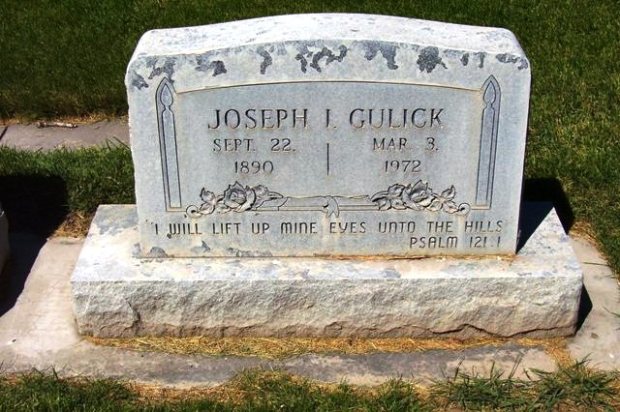
Joseph Isaac Gulick was born on a farm near White House, New Jersey in 1890.  One of his earliest memories, before he turned three, was seeing his mother frantically trying to revive his father, who had come into their house from farm work and collapsed onto the floor from heart failure.  Following his death, the family, with 4 young children, moved to his grandparents’ farm.

Joseph writes that when he was about 12, became tired of school and decided to quit.  I could see no use in “wasting time” on such things as grammar, learning to phrase and diagram.  So he went to work on neighboring farms and later learned the blacksmith trade.  After several years working as a blacksmith he was overcome with the desire to go to college, and prayed to God for months to make it possible.

God answered his prayers when after a church service, the minister pulled him aside and told him, “Joseph, I can’t understand it, but something has been working on me, pushing me, telling me that I ought to talk to you about going to college and preparing for the ministry! Have you ever thought of it?” So Joseph started the long process of finishing grade school, completing high school, and going on to college and finally seminary.

His college years were interrupted by a year of sickness.  Joseph came down with a severe case of typhoid fever, and was cared for by his mother and brothers.  At one point his heart stopped, and his mother dropped to her knees and prayed desperately for God to give him back to them.  Another time when he was sinking low, he sensed he was floating through a tunnel.  He writes, “At the end of the tunnel, light was shining.  I floated slowly toward a ball of indescribably beautiful colors!  Around about were equally beautiful sounds!  Instinctively I knew I was drawing near a theophany—a manifestation of God!”

His illness left him weak from a loss of weight and angry with God for getting even farther behind in his education and also because of a broken engagement.  He writes, “God was letting me pass through the furnace so I would understand lives of people who later came to me for help.”

He also had an experience one Sunday afternoon when he went out into the woods to “wrestle with God and while there, I had a dramatic conversion experience, not unlike St. Paul’s on the Damascus Highway.”  Many years later he wrote of it, “What a powerful evangelist I might have become had that Pressure of God’s Presence remained with me as I felt for some days after that experience of joy and inner illumination in the woods.  But though it gradually faded, I had been given both new conviction and a new life direction by it!”

Prior to his final year in Princeton Seminary, he took a summer assignment in Soda Springs, Idaho.  Back at Princeton he received many letters from individuals in Soda Springs asking him to return, and Joseph tried to persuade other students at Princeton Seminary to go.  Finally he prayed to the Lord for guidance and had an immediate answer, “Go, and I will go with you!”

Borrowing money for the trip West, Joseph arrived in Soda Springs on May 31, 1920.  In the nearly three years he spent there, the congregation grew from 36 to 105, and for the first time in their history, became self-supporting.  He began raising funds for a new building, but ran into opposition within the congregation and the community, and sensed it was time for him to move on. Soda Springs’ loss was Idaho Falls’ gain. However, just before coming to Idaho Falls, Joseph married a member of the Soda Springs congregation, Winifred Louise Ferebauer, and gained a family, as she had two young sons.

On an earlier visit to Idaho Falls, Joseph had been impressed by the architecture of the newly constructed Presbyterian Church.  He writes in his autobiography, “As I left the sanctuary, a sudden prophetic insight swept my soul, ‘This is yours!  God will call you to this church to serve it!’”

In 1919, Idaho Falls was in the midst of the post-World War I boom, enjoying a period of prosperity.  The town was growing and churches were flourishing.  The First Presbyterian Church had been organized in 1891, and that same year they built a small building at Shoup and A Streets.  They met there until 1917, when they had grown to about 260 members and were cramped in their building.  Temporarily meeting in a building hastily constructed on Eastern Avenue south of the present Museum, they began construction at their current location in 1918 and dedicated the building on April 11, 1920.  Then the depression of 1920-1921 hit.  Jobs were lost, people were leaving Idaho Falls.  The congregation of First Presbyterian, which had grown to 366 by 1920, was reduced to 155 in 1923.  Pledges that had been made toward funding the building were not being fulfilled.

According to the history of the First Presbyterian Church, “Dr. Joseph Gulick came to the church in 1923 on a starvation wage, supplementing his income by teaching history at Idaho Falls High School.”  Joseph Gulick actually taught three history classes and one English class, and for it received a salary of $150/month.  Still there came a time when he needed to withdraw the last cent from his bank account to buy groceries.  Many years later he reflected, “This was to be the story of our years of ministry in Idaho Falls—through daily prayer attempting to secure God’s guidance, and in every crisis, going into the sanctuary at night, lifting our eyes to the beautiful dome above and beseeching God for help!”  He also wrote that his time teaching at Idaho Falls High School “caused me to be favorable known by both Mormons and Gentiles.”

Rev. Gulick served at the First Presbyterian Church of Idaho Falls for 36 years.

“The first thing that needed to be done,” he wrote, “was to encourage a very discouraged congregation and to make them aware of God’s presence with them.”

 One of the first needs he focused on was building a youth group.  When he came to the church there was none, and the “Old Guard” had no interest in teens.  Within three years, over 70 were coming to the youth group meeting he started.

One of the next needs he saw was to pay off the debt for their building.  In January 1925, after his sermon he invited all the men who wanted to be part of a campaign to reduce the debt to come into his study. Nearly every man showed up; many couldn’t get in.  Both men and women took up the challenge, and Joseph later reflected, “It was a demonstration of the presence and power of God in the life of His Church.”

In January 1929, Rev. Gulick began broadcasting worship services over KGIO radio (which later became KID).  According to his autobiography, it was the first religious broadcast in Idaho.

Two of the goals of the church in 1931 were: (1) a 25% increase in average attendance and (2) a new experience of the Presence of Christ in our lives, and a new loyalty to the church and the Kingdom.  The church made that year, which was their 40th anniversary, a year of prayer.

In 1932, Joseph asked for a year of leave, in order to work on his Master’s Degree.  He took his family to Washington DC where he and his two sons all studied at George Washington University.

Coming back to Idaho Falls alone, while his sons continued their studies and his wife stayed with them, he threw himself into his ministry.  “One thing that contributed to the work pressure upon me was my inability to delegate responsibility to others.  It was my custom to pitch into every project and do everything possible that I myself could do.”  One Sunday night he discovered a leak in the church roof. As he worked to minimize the damage, he became angry at the church trustees for not repairing the roof, and an elder and his wife who were leisurely visiting with his wife instead of helping him.  The following day, as he was walking to Emerson School to give an address to the Parent Teachers Association, he became disoriented.  He eventually got to the school but as he began his talk, he felt weak, sat down, felt sharp pains in his cheeks, and then collapsed.  It was the beginning of long days of both mental and physical pain and depression.

In his words, “It was a jagged, wounding, storm-covered mountain top experience in my life, but God was in and throughout it all, hammering and tempering His instrument as the blacksmith tempers his metal in the heat and cold.”  He gives much credit to his wife for getting him through this period of weakness.  He also came to understand that because of it he could better minister to people with mental problems, and it taught him not to try to carry so much responsibility on his shoulders.

In 1947 Joseph completed his Doctor of Divinity Degree through the College of Idaho.

Remembering the years 1947-50, Dr. Gulick writes, “If certain important events were like mountain peaks on the skyline of Idaho Falls Presbyterian Church history, the “New Life Movement” launched by the General Assembly in 1947 was the Mount Everest of them all! It was the period in the Idaho Falls Church’s history when the Holy Spirit’s directing Presence and Power, like that reported in the Book of Acts, was felt more vividly than at any other time.”

 Prior to this date, for many years the church had not been adding more than 20 members annually.  And over the years Dr. Gulick had become sort of a “Community Pastor,” with an increasing load of funerals, counselling sessions and community demands. [He was also called “The Fishing Preacher,” as he spent one day, and sometimes two days, each week during fishing season on the river.]  One focus of the New Live Movement was personal witness.  Following a 5-day training session at a Regional Conference and a sermon series focused on an individual’s relationship with Christ, teams were ready.  On Monday, November 17, 1947, 18 men went out in pairs to share the gospel.  Though 16 of the 18 men had never spoken to anyone about a relationship with Christ before, that day the teams led 21 people in decisions to become followers of Christ.  The following Sunday 50 people became new members of the church, and over the next 13 months more than 175 people found Christ.  Dr. Gulick writes, “Though I had always relied upon the Holy Spirit, I needed to realize that the Holy Spirit can work through others as well as myself, and it is wisdom to involve others, especially the men, in the work of church visitation.”

After 30 years of ministry in Idaho Falls, Dr. Gullick took a sabbatical in 1953 to study for six months in Israel, Egypt and Europe.  After getting home he showed slides of his trip 96 times and gave 21 lectures based on what he saw and learned.

Dr. Gulick’s final Sunday in the pulpit at the Presbyterian Church in Idaho Falls was June 28, 1959, but his ministry was not over.  The first year of his “retirement,” Dr. Gulick served as the District Governor of Rotary.  During the next seven years he led churches in Swan Valley, Ririe and Rigby.  In 1967 he entered into complete retirement in order to devote himself completely to the care of his wife, who was suffering from declining health, and passed away in September, 1969.   Joseph Gulick died in Idaho Falls on March 3, 1972.

[Note: My primary source for the above was a copy of the first 118 pages of his autobiography, Joseph I Gulick, God’s Missionary, privately published and undated.  I have not been able the find the remaining 152 pages.  If you have a copy or know of one, or have memories of Dr. Gulick that would add to this story, please contact me.]